
Deep Dive into Carbon Fiber: The "Black Gold" Reshaping Future Industries
Explore the microscopic strength of carbon fiber and its core applications in aerospace and NEV lightweighting. Discover how China dominates 60% of the global market as costs drop, paving the way for the "Black Gold" revolution
6/29/20263 min read
Deep Dive into Carbon Fiber: The "Black Gold" Reshaping Future Industries
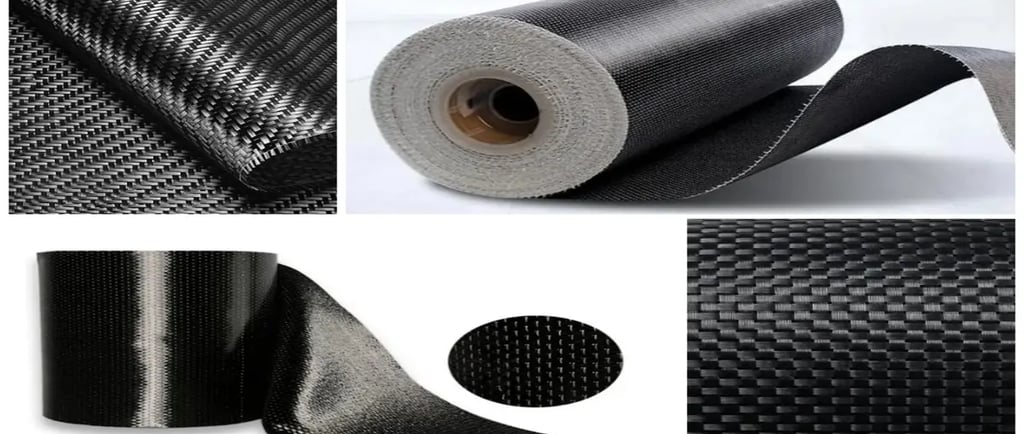
In the realm of modern materials science, carbon fiber is widely recognized as the "King of Lightweighting." Breaking the traditional physical law that "lightweight and high strength cannot coexist," it is reshaping the body of modern industry with unstoppable momentum.
The extraordinary strength of carbon fiber originates from its ingenious microscopic structure. It consists of stacked graphite microcrystals, with carbon atoms arranged closely along the longitudinal axis of the fiber and connected by strong covalent bonds. This highly oriented structure endows it with exceptional strength and modulus. Meanwhile, carbon fiber exhibits obvious "anisotropy," meaning its performance varies significantly depending on the direction of the applied force.
Mechanically, the density of carbon fiber is only 1/4 that of steel, yet its tensile strength reaches an astonishing 3000~7000 MPa, several times higher than that of premium steel. Furthermore, it acts as an "environmental immune system": it can withstand extreme heat of 2000~3000°C in an oxygen-free environment, remains flexible at a freezing -180°C, and boasts low thermal expansion, acid/alkali resistance, and superior fatigue resistance.
Aerospace: Carbon fiber accounts for over 50% of the structural weight in the Boeing 787 and Airbus A350XWB, reducing weight by over 20% and significantly boosting fuel efficiency. Domestic large aircraft like the C919, as well as fighter jets like the F-35, extensively utilize it to enhance maneuverability and stealth capabilities.
Wind Power & Frontier Fields: The main spars of large wind turbine blades adopt carbon fiber to reduce weight and improve wind energy capture efficiency. Additionally, it is widely used in post-earthquake building reinforcement, high-pressure hydrogen storage tanks, and 5G base station antennas.
In the new energy vehicle (NEV) and supercar sectors, carbon fiber is the key to achieving ultimate lightweighting. Studies show that for every 10% reduction in vehicle weight, the driving range can be increased by 5%-10%. Its applications mainly include:
Body Structural Parts: For instance, the full carbon fiber passenger cell in the BMW i3 is 300kg lighter than a traditional steel body, extending the driving range while absorbing massive energy during collisions to ensure safety.
Chassis & Drivetrain: Carbon fiber drive shafts reduce weight by 40%-50%, resulting in lower rotational inertia and more direct power delivery. Carbon fiber wheels and suspension control arms lower unsprung mass, significantly enhancing acceleration, braking response, and handling precision.
Interior, Exterior & Functional Parts: Carbon fiber hoods and roofs lower the vehicle's center of gravity. Carbon fiber intake manifolds offer excellent thermal insulation to improve engine combustion efficiency. It is also frequently used in high-end interior panels, combining a tech-savvy aesthetic with wear resistance.
The high cost once limited the widespread adoption of carbon fiber, but a "mass-market revolution" is now underway. This is driven by the scaling of 60K large-tow technology (reducing costs by ~30%), the advancement of high-efficiency processes like dry-jet wet spinning, and the localization of critical equipment such as carbonization furnaces (pushing the yield rate up to 92%).
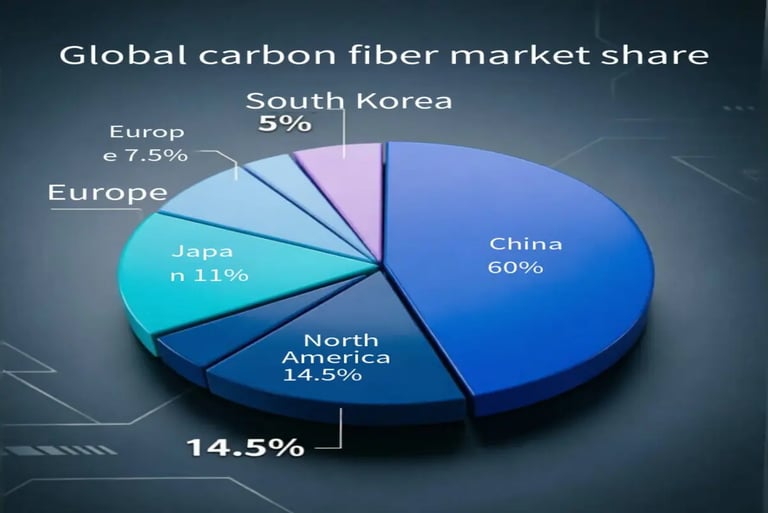
Looking at the global market landscape, the global carbon fiber market size exceeded $30 billion in 2024. Currently, China holds a dominant position with approximately 60% of the global market share, thanks to its entire industry chain advantage. The remaining ~40% is primarily shared by North America (~14.5%), Japan (~11%), Europe (~7.5%), and South Korea (~5%). By 2030, global demand is projected to surpass 400,000 tons. As costs continue to drop, carbon fiber will penetrate broader fields like mass consumer goods and rail transit, pulling the world toward a lighter and greener future.


1. Exploring the Microscopic: Why is Carbon Fiber So Strong?
2. Shining in Core Applications
3. Automotive Lightweighting: Core Component Applications
4. Breaking the Price Barrier: Cost Reduction & A Vast Blue Ocean
Get in touch
Address
No. 75 Tianlin east Road ,Xuhui Distrct,Shanghai,China
Contacts
Email:sales@autolightcarbon.com
AutoLight Carbon ( ALC) is an integrated factory and trading company. We supply and customize automotive carbon fiber lightweight parts, carbon fiber drone components and sports equipment. Wholesale and small-batch orders are all welcome.
About Us
Copyright © 2026 AutoLight Carbon (ALC). All rights reserved.
Quick Links